

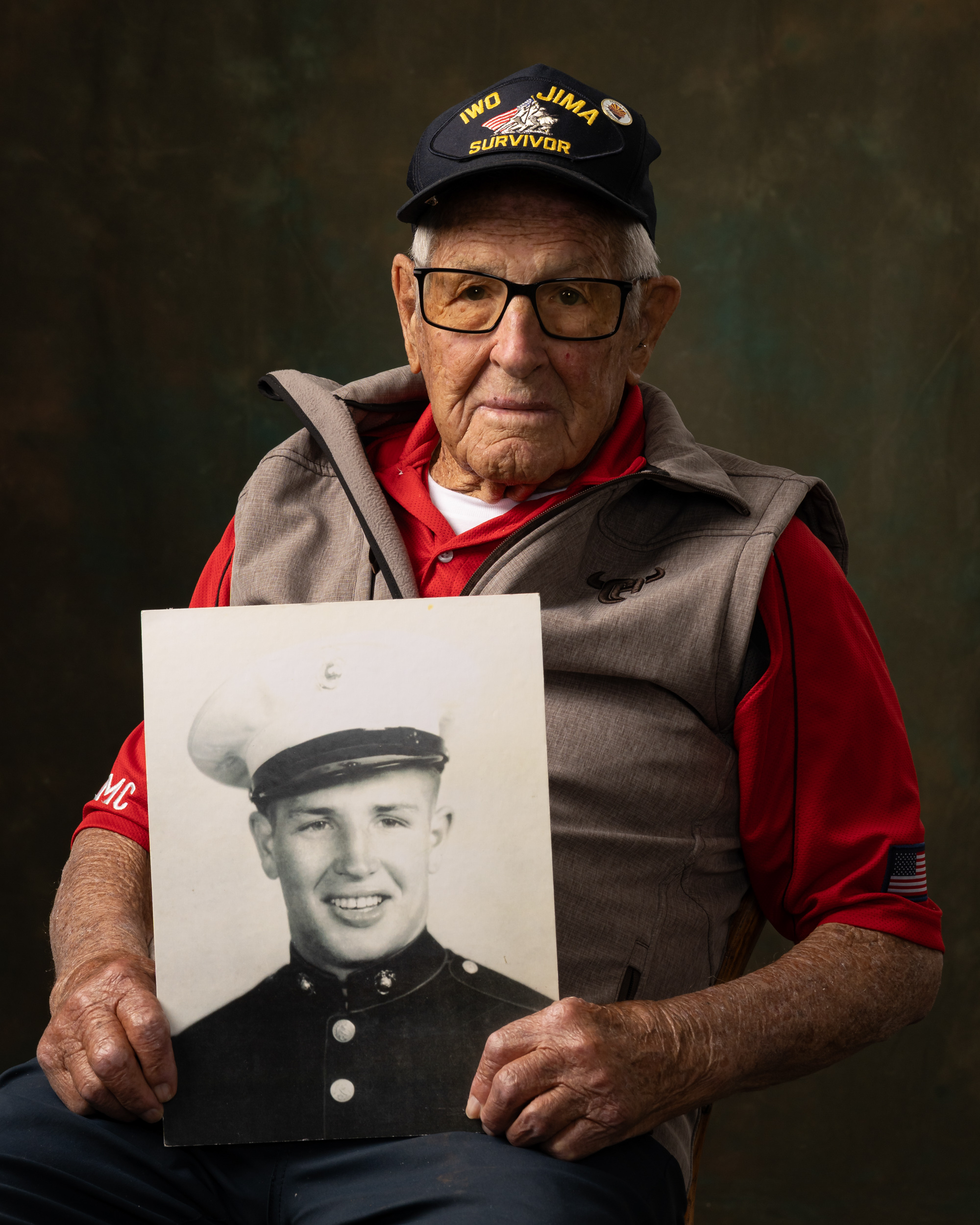
Robert Brutinel
Written by Sue Tone
U.S. Marine Corps PFC Robert Brutinel served in the South Pacific during World War II on Guadalcanal, Vella Lavella, Iwo Jima, and in occupied Japan.
Born in 1924, Brutinel grew up in the tiny copper mining town of Clifton on the eastern border of Arizona and New Mexico during the Great Depression. His father served as an interpreter in World War I. His grandfather fought in the trenches in France. As soon as he turned 18 in September 1942, his mother finally allowed him to enlist in the Marines.
Bruntinel first served with the 1st Marine Paratroopers where he fought the Japanese in the Battle of Guadalcanal. From there, he was sent to Vella Lavella in the Solomon Islands. He had just disembarked from the LST (Landing Ship, Tank) when a Japanese plane dropped a bomb on the ship. The concussion knocked him down, but he wasn’t injured.
His unit was tasked with clearing out enemy Japanese that remained on the islands. At one point, half of his outfit got separated and were picked up by Capt. John F. Kennedy’s PT-109 before reuniting with his group.
By early 1945, Bob was with the 5th Division in Hilo, Hawaii, after volunteering to train as a flame thrower. He briefly described how this weapon contains a napalm-like substance that sticks to the skin, 100 octane fuel, and gunpowder. “It’s horrible,” he said. “I wasn’t very proud of it. It’s a hell of a way to die.”
He was in the first wave of Marines sent into Iwo Jima where he spent two months. Nearly 7,000 Marines lost their lives in the Battle of Iwo Jima over the course of a brutal five weeks of fighting.
On March 12, 1945, two weeks before the island was secured, Brutinel charged a Japanese pillbox firing his flame thrower until it ran out of fuel. He returned to the company supply and refueled, attacking the pillbox once again until the enemy was silenced. For this he was awarded the Silver Star.
Brutinel said he didn’t believe in medals. “I never have. The only reason you get a medal is because somebody important saw you do something, which was supposed to be your job.”
Two days later, he volunteered to take a corpsman to another area, and a sniper bullet hit him. He was awarded the Purple Heart.
After the atomic bombings of Hiroshima and Nagasaki, and the signing of the Armistice on Sept. 2, 1945, Brutinel was sent to Kyushu as part of the occupation of Japan. Two weeks later one of the deadliest typhoons in Japanese history hit the area killing nearly 3,000 people. He said the winds tore down the latrines and blew away the mess hall. Soon after, he had enough points to fulfill his service requirements, and he re-entered civilian life in late 1945.
When asked what he learned from serving in the military, Brutinel said, with a hearty laugh, “Don’t volunteer for anything.”